• New Zealand Finance minister Willis talking yesterday said NZ inflation may hit 7.4% in a worst-case scenario if the war in Iran continues. She also went on to suggest GDP this year could be limited to 0.8% with unemployment topping out around 5.8%.
• Iran has tightened the control of the Hormuz strait after US delays renewed attacks. President Trump saying he was calling off attacks indefinitely as no sign of any peace talks exist. Trump also warned to expect high fuel costs for longer which has wider implications to world inflationary targets.
• Eurozone optimism took a hit yesterday after Germany slashed their growth outlook in half.
• Anyone hoping the Federal Reserve would be cutting rates soon, will be disappointed as FED easing forecasting has been pushed out to 2027 with rising inflation complications.
• Rising inflation in Japan has reinforced a cautious policy stance with softer manufacturing and falling confidence. The Bank of Japan’s (BoJ) expect to keep rates unchanged until midyear depending on how rising inflation takes effect.
• Crude is up 4.0% in overnight trading to 97.00 per barrel as Middle East hostilities worsened.
• The Australian Dollar (AUD) has been the strongest currency in the past week while the Japanese Yen (JPY) the worst performer.

With the strait of Hormuz still blocked Crude Oil prices are again on the rise. News of no peace deal and the Hormuz blockade keeping oil supply constrained wont initially have “transitory” implications, it will cause longer term inflationary rises. The New Zealand Dollar (NZD) slumped off 0.5920 levels Thursday as risk markets deteriorated clocking 0.5840 into Friday. Geopolitical headlines will continue to impact NZD moves, certainly topside prices could remain limited.
The current interbank midrate is: NZDUSD 0.5854
The interbank range this week has been: NZDUSD 0.5837- 0.5922
The Australian Dollar (AUD) remains well supported on dips against the New Zealand Dollar (NZD) late this week with prices hovering around highs at 1.2180 (0.8210). The New Zealand Dollar (NZD) lost momentum midweek doing a U-turn off 0.8260 (1.2105) as market risk sentiment weakened. NZ Inflation rose in the March 2026 quarter to 0.9% above 0.8% forecast leaving the y/y figure at 3.1%- outside the RBNZ’s target zone of 1-3%. Australian CPI data is next week with the first quarter figure expected to print around 4.5% off 3.7%. Until central bank policy changes, we expect the bear channel to progress.
The current interbank midrate is: NZDAUD 0.8207 AUDNZD 1.2175
The interbank range this week has been: NZDAUD 0.8201- 0.8261 AUDNZD 1.2105- 1.2193
It’s been a game of two halves this week for the New Zealand Dollar (NZD) clawing back losses to 0.4380 (2.2825) against the British Pound (GBP) before retreating to 0.4345 (2.3020) this morning. UK CPI y/y printed at 3.3% in March bang on expectations but has jumped from 3.0% providing confirmation the war in Iran and increased fuel prices is impacting. UK Retail Sales prints tonight and should come in a benign 0.0%. We expect the GBP to extend gains to 0.4325 (2.3120) into the close of the week.
The current interbank midrate is: NZDGBP 0.4346GBPNZD 2.3009
The interbank range this week has been: NZDGBP 0.4341- 0.4381GBPNZD 2.2822- 2.3036
The Euro (EUR) traded heavy against the New Zealand Dollar (NZD) into Thursday, the cross reaching 1.9810 (0.5050) before pulling back on risk sentiment to reach 1.9980 (0.5005). Earlier we saw German deteriorating growth expectations mixed with general favourable risk bias for the NZD before Middle Eastern tensions amplified all helping to send the NZD lower. The kiwi may struggle to gain encouraging topside bias while conditions in the strait of Hormuz are shaky.
The current interbank midrate is: NZDEUR 0.5009EURNZD 0.4977
The interbank range this week has been: NZDEUR 0.4988- 0.5048EURNZD 1.9809- 2.004
Markets towards the close of the north American sessions were slightly “risk off” leaning with the US Dollar (USD) firming as geopolitical tensions in the strait of Hormuz ramp up. Trump has warned of longer-term inflation fallout as the strait is closed for extended periods, which may cause longer term fuel costs. The Australian Dollar (AUD) has held up reasonably well in the face of decent PMI readings however the ongoing strength in the greenback and uncertainty around the commodity linked China demand could limit upside momentum. With the AUD/USD trading around 4-year highs resistance around 0.7160 could be hard to crack.
The current interbank midrate is: AUDUSD 0.7130
The interbank range this week has been: AUDUSD 0.7110- 0.7185
The Australian Dollar (AUD), British Pound (GBP) cross has tracked sideways over the week around 0.5300 (1.8860) levels with no real direction. Shifting geopolitical risk has held the pair motionless with dynamics in the Strait of Hormuz becoming complicated. UK CPI came in at the anticipated 3.3% off 3.0% raising concerns by the Bank of England (BoE) around rising inflation forecasts and higher lingering fuel costs. We expect the BoE to hold rates this year despite geopolitical effects.
The current interbank midrate is: AUDGBP 0.5293GBPAUD 1.8892
The interbank range this week has been: AUDGBP 0.5282- 0.5310GBPAUD 1.8832- 1.8931
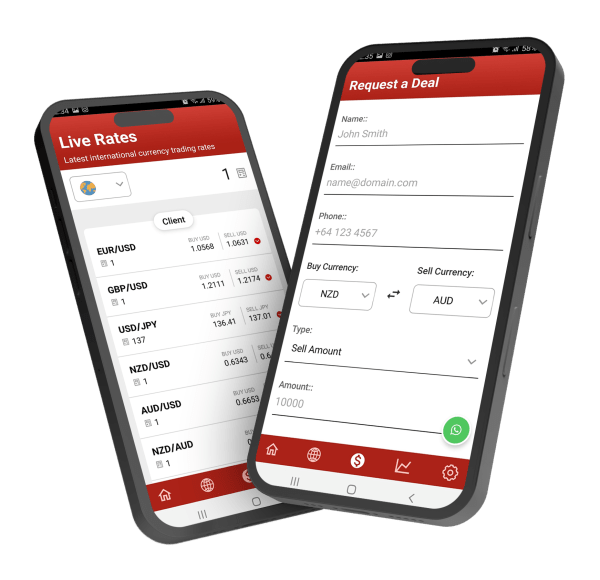
The Direct FX app has been updated to include currency charts and the highs/lows for the past 24 hours. Along with our regular market commentary, the Direct FX app also has live indicative market mid rates and a currency conversion calculator. Use the relevant link below to take you directly to the version for you, or simply search for it in the App store / Play store.