• President Trump has said he has held talks with Iran officials and has postponed upcoming strikes on Iranian power plants. Problem is Iran have denied these talks ever took place. Earlier president Trump and the UK Prime Minister Starmer agreed to re-open the strait of Hormuz in order to resume the key global shipping route which accounts for around 20% of the worlds Crude Oil traffic. Over the weekend Trump said he would “obliterate” Iranian power plants if the strait wasn’t opened up over the next 48 hours. Iran have said they will “completely” close the strait if their energy resources were struck.
• Markets turned “risk on” post the Trump news starting with Crude oil settling around 88.00 a barrel. The DOW index spiked 2.0% and the NZD and AUD were both up over 1% in overnight trading.
• New Zealand 4th quarter GDP came in at 0.2% well below forecasts of 0.5% and third quarter’s 0.9% raising concerns for a smooth ride out of recent tough economic times.
• Goldman Sachs has raised its probability of a US recession from 5% to 30% over the next 12 months.
• The Japanese Yen (JPY) is the strongest currency this week while the Euro (EUR) is the worst performer.

The New Zealand Dollar (NZD) pushed higher off the open against the US Dollar (USD) rising to 0.5890 before slipping to 0.5760 levels in late Monday sessions. President Trump came out and said he is stalling strikes on Iran power plants after holding talks with Iran. The Tehran have called the talks “fake news”. The news immediately rallied risk products and the NZD rose to 0.5885. With little economic data to print this week geopolitical headlines will again drive market sentiment. It’s certainly an interesting time with our market risk indicator swinging wildly off headline news.
Current Level: 0.5851
Support: 0.5770
Resistance: 0.5900
Last week's range: 0.5775- 0.5892
Australian unemployment rose to 4.3% off 4.1%, the highest level in 3 months with fulltime jobs falling 30,000 in February. The labour market is definitely trending higher with expectations it may top out towards 4.7% mid 2027. Recent data suggests the Australian economy is starting to look troubled, certainly as unemployment rises, we should see inflation forecasts drop, the questions will be whether this influences the need for future rate cuts. The Australian Dollar (AUD) has underperformed over the past week against the New Zealand Dollar (NZD) with prices falling off 0.8230 (1.2150) areas to 0.8370 (1.1950) this morning. This shift above 0.8335 (1.2000) could signal a bigger move higher in the short to medium term
Current Level: 0.8350
Support: 0.8250
Resistance: 0.8420
Last week's range: 0.8231- 0.8311
Current Level: 1.1960
Support: 1.1880
Resistance: 1.2120
Last week's range: 1.2031- 1.2149
The New Zealand Dollar (NZD) extended its run lower Monday against the British Pound (GBP) dropping to 0.4345 (2.3020) overnight. This level wasn’t to hold however with Trump headlines around the Iran conflict supporting strong rallies in risk products. The kiwi kicking back to 0.4375 (2.2860) where it settled. UK CPI y/y is expected to come in at 3.0% tomorrow which will be the lowest read since early 2025. Depending on geo headlines we may see a retest this week of the low at 0.4350 (2.3000).
Current Level: 0.4358
Support: 0.4350
Resistance: 0.4365
Last week's range: 0.4361- 0.4405
Current Level: 2.2946
Support: 2.2900
Resistance: 2.3000
Last week's range: 2.2711- 2.2927
The Euro (EUR) has outperformed the New Zealand Dollar (NZD) in early week moves dropping to 0.5020 (1.9930) before settling around the 0.5050 (1.9800) area. The Iran conflict has kept the strait of Hormuz effectively closed with elevated oil and gas prices advancing inflation woes in the Eurozone. ECB officials have hinted at a possible hike to interest rates as early as April if the outlook declines. We think the cross could be back at 0.5000 (2.000) in the coming days.
Current Level: 0.5041
Support: 0.5000
Resistance: 0.5115
Last week's range: 0.5039- 0.5097
Current Level: 1.9837
Support: 1.9550
Resistance: 2.000
Last week's range: 1.9618- 1.9842
In extremely choppy market conditions we have seen the Australian Dollar (AUD) drop Monday to 0.6910 against the US Dollar (USD) before a fresh “risk rally” took prices to 0.7060 before finally settling around the 0.7000 zone. Geopolitical headlines are causing massive shifts in currency and commodity prices across the board. Rising commodity prices should keep the Aussie in demand fuelled by middle eastern tensions. Australian CPI for February prints tomorrow and should remain elevated at 3.8%. A retest of 0.7150 looks favourable depending on USD strength from the safe haven buy.
Current Level: 0.7005
Support: 0.6920
Resistance: 0.7150
Last week's range: 0.6983- 0.7123
The Australian Dollar (AUD) rally from mid-January’s 0.4965 (2.0140) level this year has ended. The British Pound (GBP) has been back in favour over the past two weeks in our “risk off” world as the preferred safe- haven takes control. The AUD has fallen out of support briefly with the labour market showing signs of weakness and a less hawkish RBA. Midday Tuesday the cross is trading around 0.5215 (1.9170) and looks to target the zone around 0.5170 (1.9350) this week.
Current Level: 0.5217
Support: 0.5150
Resistance: 0.5340
Last week's range: 0.5261- 0.5332
Current Level: 1.9168
Support: 1.8740
Resistance: 1.9420
Last week's range: 1.8753- 1.9005
The Australian Dollar (AUD) bull rally from mid-January has ended with prices dropping outside the long-term channel at 0.6110 (1.6360) yesterday. The Aussie has come under pressure in the past couple of weeks from risk off sentiment amid geopolitical uncertainty even though we have seen commodity prices rise such as Iron ore. ECB’s Nagel has indicated the central bank may hike interest rates as soon as April if the situation in Iran worsens as soaring energy prices will be prolonging Eurozone growth.
Current Level: 0.6034
Support: 0.6000
Resistance: 0.6185
Last week's range: 0.6070- 0.6173
Current Level: 1.6572
Support: 1.6170
Resistance: 1.6650
Last week's range: 1.6198- 1.6474
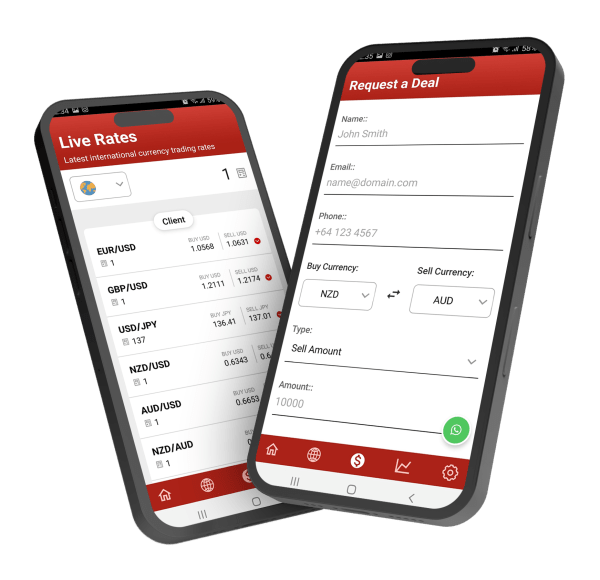
The Direct FX app has been updated to include currency charts and the highs/lows for the past 24 hours. Along with our regular market commentary, the Direct FX app also has live indicative market mid rates and a currency conversion calculator. Use the relevant link below to take you directly to the version for you, or simply search for it in the App store / Play store.