• Trump proposes a 5 billion Gulf rebuilding plan to reduce the reliance of traffic through the Strait of Hormuz. Talks between Middle Eastern countries have been held discussing alternative transportation routes reducing the dependence of the Strait.
• The US President will host Xi later this week at the White house, the first visit in over a decade.
• All 4 Australian Banks now expect the Reserve Bank of Australia (RBA) to hike to 4.60% on the 29th of September. Market’s have accordingly baked this into price with chances seen now at 90%.
• Oil prices track back under 100.00 per barrel on improved risk sentiment; however, investors weigh up Houthi missile attacks on Ridadh.
• The Bank of England (BoE) left interest rates unchanged last night at 3.75% in a 6-3 vote. The Central Bank floating the option of a November rate rise if energy prices don’t retreat back to normal levels.
• The Bank of Japan (BoJ) raised interest rates from 1.0% to 1.25% Friday as expected, the highest it’s been in 31 years. The review was “dovish” improving the Japanese Yen (JPY) after the release even though markets expect the Bank of Japan to raise rates again to quell inflation.
• US Stocks closed higher with treasury yields easing.
• The strongest G10 board currency last week was the US Dollar (USD) while the worst performing currency has been the Japanese Yen (JPY) post the Bank of Japan dovish hike to 1.25%.

The New Zealand Dollar (NZD) held levels around 0.5700 on the Monday open against the US Dollar (USD) after weeks of underperforming. The kiwi should be well supported around the 0.5680 zone if it retests this area over the week. With a lack of data printing this week price action will most likely be driven from the geopolitical scene and risk sentiment. Generally, the kiwi remains under pressure with a cautious tone from the RBNZ and a hawkish Fed.
Current Level: 0.5705
Support: 0.5670
Resistance: 0.5820
Last week's range: 0.5702- 0.5817
Second quarter GDP in NZ printed at 0.4% recently above expectation of 0.2% and above that of Australian GDP growth over the first 2 quarters. This should be lending support for a stronger New Zealand Dollar (NZD), but it hasn’t eventuated based on a central bank interest rate diverging forecast. This morning we have seen the NZD/AUD trade lower to 0.8015 (1.2480), remembering we have not seen the cross trade in the 70’s since March 2013. Unless something fundamentally changes the downside bias in the kiwi, we could expect a look at big figure 0.8000 (1.2500) in the coming hours/days. Key Australian employment data prints Thursday and could swing the cross either way.
Current Level: 0.8010 (1.2471)
Support: 0.7975 (1.2280)
Resistance: 0.8145 (1.2540)
Last week's range: 0.8015- 0.8130 (1.2299- 1.2476)
NZ GDP printed at 0.2% in the second quarter, above the 0.1% markets were expecting adding a touch more complexity to the RBNZ interest rates debate. Certainly, since the RBNZ held we have not seen the kiwi catch a break- it’s all been one way traffic to the downside. The is cross currently trading around the weekly open at 0.4275 (2.3400) looking bearish. The next point of concern is the area at 0.4270 (2.3430), if we see a break below this zone, we are back into mid 2015 levels. Attention lies with UK manufacturing tomorrow to offer a steer on direction.
Current Level: 0.4265 (2.3446)
Support: 0.4250 (2.3260)
Resistance: 0.4300 (2.3540)
Last week's range: 0.4257- 0.4298 (2.3262- 2.3487)
The New Zealand Dollar (NZD) travelled through big figure 0.5000 this morning, matching levels of July this year against the Euro. There doesn’t seem to be much in the way of broad support for the kiwi at the moment with massive bearish momentum post the recent RBNZ dovish hike. Growth in the Eurozone printed well recently at 0.4% for the second quarter giving more emphasise on the ECB hiking cycle. If this week’s Eurozone manufacturing prints above forecast, we could see the EUR strengthen further.
Current Level: 0.4973 (2.0108)
Support: 0.4945 (2.000)
Resistance: 0.5000 (2.0215)
Last week's range: 0.4972- 0.5020 (1.9919- 2.0110)
The pullback off last week’s low at 0.7075 remains intact in the Australian Dollar (AUD), US Dollar (USD) cross clocking 0.7140 Monday before easing to 0.7120 early this morning. Downside moves look to be well supported at the current level with signs we could see price around the 0.7140 area today. RBA governor Bullock speaks later today about the Australian economy which could give the AUD volatility, this comes ahead of employment data Thursday with unemployment predicted to print unchanged in August at 4.5%.
Current Level: 0.7117
Support: 0.7080
Resistance: 0.7220
Last week's range: 0.7074- 0.7166
The Australian Dollar (AUD) sits just below early June highs this morning at 0.5330 (1.8770) against the British Pound (GBP). With divergence between the BoE and RBA in play we expect further bullish continuation from the AUD. With markets pricing in a hike at the RBA 29 Sep meet this should offer a steer higher for the Aussie. Australian employment data should print ‘no change’ at 4.5% Thursday.
Current Level: 0.5321 (1.8793)
Support: 0.5275 (1.8750)
Resistance: 0.5330 (1.8950)
Last week's range: 0.5277- 0.5338 (1.8732- 1.8950)
The Euro (EUR) started the week extending last week’s moves lower from 1.6120 (0.6200) reaching 1.6100 (0.6210) in early morning trade just below the long term 1.6080 (0.6220) zone of November 2024. Both Lagarde and Gov Bullock speak this week on economic future hinged around energy prices and the roll this plays in determining monetary policy.
Current Level: 0.6205 (1.6116)
Support: 0.6155 (1.6080)
Resistance: 0.6220 (1.6250)
Last week's range: 0.6163- 0.6217 (1.6084- 1.6225)
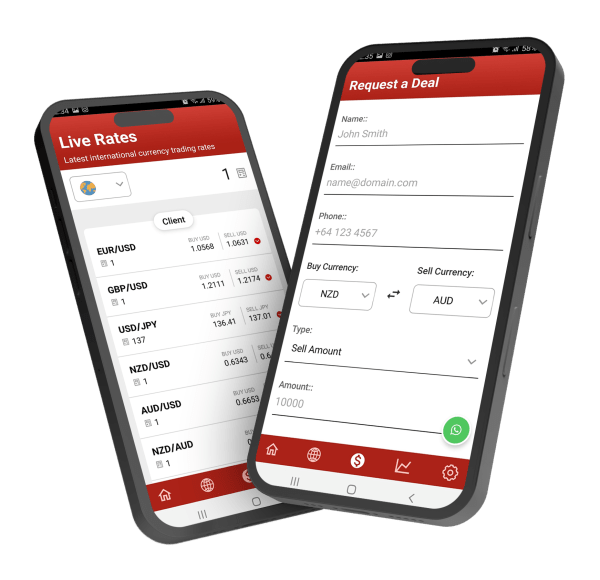
The Direct FX app has been updated to include currency charts and the highs/lows for the past 24 hours. Along with our regular market commentary, the Direct FX app also has live indicative market mid rates and a currency conversion calculator. Use the relevant link below to take you directly to the version for you, or simply search for it in the App store / Play store.