• The US-Iran war drives up the safe haven demand sending shockwaves through markets. Joint Israel-US led strikes on Iran over the weekend has killed Iran’s leader Ayatollah Ali Khamenei. Iran has launched retaliation rockets targeting US Military bases across gulf countries fuelling a wider conflict.
• Gold has rallied to 5,400 in NY sessions.
• The closure of the strait of Hormuz which equates for roughly 20% of the global oil and gas supply route has sent crude prices sharply higher to $70- up nearly 6.0% from the previous day.
• The Federal Reserve (Fed) held rates in January. Minutes from this meeting confirmed participants are keen on rate hikes if inflation stays above target.
• The New Zealand Dollar (NZD) trades under pressure Monday easing from above key 0.6000 to 0.5940 style levels and may attract further selling pressures as the week progresses.
• The Australian Dollar (AUD) has been the strongest currency this week while the weakest performing currency has been the Japanese Yen (JPY)

The New Zealand Dollar (NZD) has lost ground Monday against the US Dollar (USD) dropping to print 0.5915 early this morning before bouncing slightly to 0.5950. Risk off sentiment flows is keeping the kiwi capped below 0.6000 and may continue if the war in Iran continues. We have no NZ data publishing this week of note but plenty of US data coming out at the end of the week including (NFP) Non-Farm Payroll and unemployment to cause additional volatility.
NZD/USD
Current Level: 0.5945
Support: 0.5900
Resistance: 0.6070
Last week's range: 0.5941- 0.6012
Nothing has changed in the New Zealand Dollar (NZD), Australian Dollar (AUD) view we have been singing for a while now. The kiwi dropped further Monday to 0.8370 (1.1947) as I write as we forecast it might with the AUD still charging. Central Bank divergence in the cross seems to have never been wider causing the massive multiyear momentum in the AUD. RBA's Bullock spoke this morning saying the labour market remains tight but they were uncertain around inflation returning to the target midpoint at 2-3% suggesting this may be mid-2027. She also said crude oil price shocks could add to inflation pressures. Buying AUD consider on spikes.
NZD/AUD (AUD/NZD)
Current Level: 0.8364 (1.1943)
Support: 0.8300 (1.1800)
Resistance: 0.8475 (1.2050)
Last week's range: 0.8405- 0.8468 (1.1809- 1.1898)
The New Zealand Dollar (NZD) is down against the British Pound (GBP) Monday after investors exited the NZD on risk sentiment- prices fell to 0.4430 (2.2560) in late NY Tuesday. Central bank interest rate differentials are starting to shift with the Bank of England (BoE) factoring in rate cuts later in the year, while not overly dissimilar to the Reserve Bank of New Zealand's (RBNZ) policy with the RBNZ more restrictive looking ahead through 2026. We forecast a return by the cross to 0.4485 (2.2300) levels in the short to medium term.
NZD/GBP (GBP/NZD)
Current Level: 0.4432 (2.2563)
Support: 0.4405 (2.2400)
Resistance: 0.4465 (2.2700)
Last week's range: 0.4408- 0.4466 (2.2390- 2.2683)
For weeks now the New Zealand Dollar (NZD), Euro (EUR) has been choppy pivoting around 0.5075 (1.9700) levels. Ongoing tariff threats and uncertainty in the middle east between Iran and USA is detrimental for the EUR, however the NZD has struggled for upside in this "risk off" market since late last week. Meanwhile, the German economy is showing signs of improvement, but the recovery will be slow. Softer eurozone inflation raises further questions around ECB rate cuts with the ECB expected to hike interest rates in 2027. We expect the NZD to track towards key levels around 0.5120 (1.9530) in the mid-term.
NZD/EURO (EURO/NZD)
Current Level: 0.5082 (1.9677)
Support: 0.5050 (1.9530)
Resistance: 0.5120 (1.9800)
Last week's range: 0.5048- 0.5086 (1.9660- 1.9808)
The Australian Dollar (AUD) is weaker, under pressure from the safe-haven demand flows with escalating conditions in Israel-Iran tensions. The AUD clocked its 8th week of gains over the greenback, but the 9th could be testing if the risk off tone continues over the week. Only a break above 0.7150 would confirm easing in the middle east region. Aussie GDP is predicted to come in at 2.2% y/y after 1.8% growth in 2025. The RBA is expected to hike interest rates later in the year but hold on March 17th.
AUD/USD
Current Level: 0.7105
Support: 0.7040
Resistance: 0.7150
Last week's range: 0.7025- 0.7136
The Australian Dollar (AUD) has gained off Monday’s open to reach 0.5295 (1.8880) against the British Pound (GBP). We see further support for the AUD this week with prices retesting the 0.5375 (1.8600) area- the December 2023 level. Technically the cross has been deep in a bull channel since early January’s 0.4970 (2.0130), a dip towards 0.5200 (1.9230) areas is needed to signal fresh downside bias. UK Chancellor Reeves delivers her spring statement tomorrow morning providing an update to the UK’s economic plans covering growth, inflation, unemployment and tax.
AUD/GBP (GBP/AUD)
Current Level: 0.5295 (1.8885)
Support: 0.5195 (1.8670)
Resistance: 0.5355 (1.9250)
Last week's range: 0.5212- 0.5302 (1.8859- 1.9185)
Despite a risk off tone Monday in markets the safe-haven Euro (EUR) has retreated off 1.6700 (0.5990) to trade to 1.6460 (0.6075) weakening against the Australian Dollar (AUD) in morning trade. This zone sits perilously close to a December 2024 key zone. Governor Bullock was on the wires this morning saying February's rate hike was justified but the war in the Middle East adds to uncertainty and that prolonged market shock could have adverse effects to the global economy.
AUD/EURO (EURO/AUD)
Current Level: 0.6073 (1.6466)
Support: 0.5960 (1.6445)
Resistance: 0.6080 (1.6780)
Last week's range: 0.5970- 0.6040 (1.6559- 1.6748)
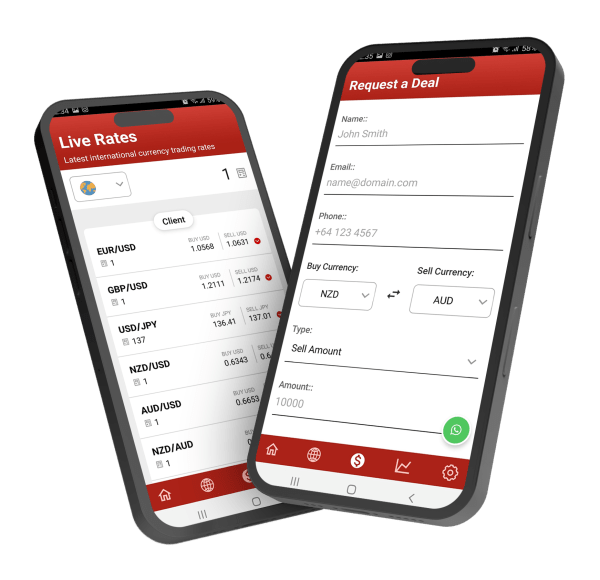
The Direct FX app has been updated to include currency charts and the highs/lows for the past 24 hours. Along with our regular market commentary, the Direct FX app also has live indicative market mid rates and a currency conversion calculator.